The Weight of the Blueprint
8,100 miles from home, the blueprint broke. This is how I learned to build when the plans are lost.
8,100 Miles From Home, The Blueprint Broke.
Most people see the “Google” on my profile and assume a linear path of success. They don’t see how my life is the result of a series of survival steps.
In 1998, my family flew 8,100 miles to immigrate from the Philippines to the US. The blueprint for our new life was simple: My father, Manuel—who had been a Director at TESDA and an Electronics Engineer back home—would trade his position and prestige for a survival job to provide the foundation.
My parents would reestablish our roots in Chicago, providing for me and my sister while we worked to bring my older brother over. I would focus entirely on my education so I could eventually take over the “heavy lifting.”
It was a solid plan. A classic immigrant blueprint.
The Break
But not even a year after landing in Chicago, the blueprint broke.
In August 1999, a sudden heart attack took my father—just weeks after I turned 20 and only three days before his 50th birthday. In an instant, the primary architect of our family’s future was gone. The foundation wasn’t just cracked; it was shredded.
I had to forget what it meant to be “just a student.” I had to become the oldest son and help my mom provide for the family while navigating a grief I didn’t have time to process.
How do you build when the plans are lost? We chose to push through. I decided the only way forward was to redraw the lines but honor the path I had already planned with my dad. I took a part-time job while committing to the herculean task of finishing my degree.
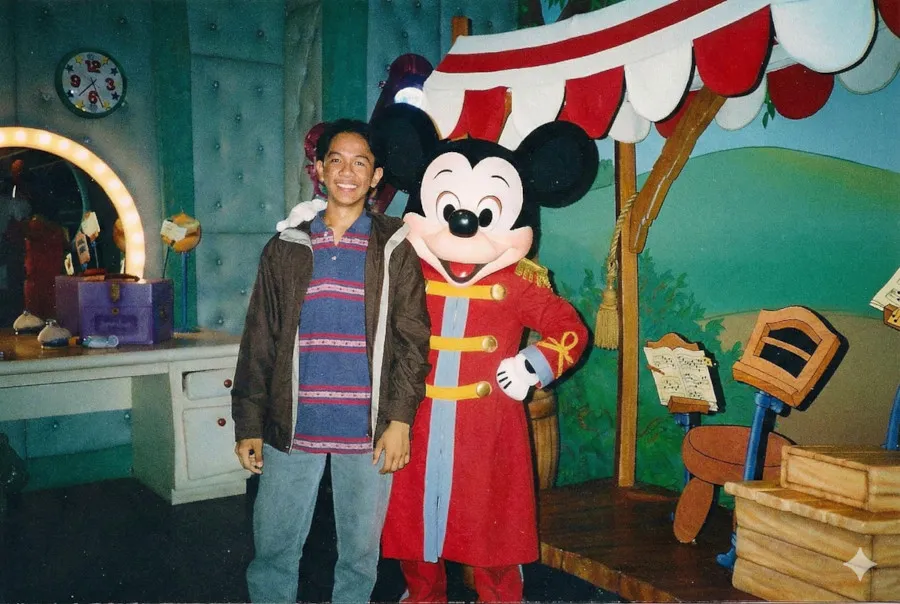 Nov 1998: My first week in the US. I was 19, standing at Disneyland, looking at a future I thought was guaranteed.
The Professional Bridge
I’ve reflected on this, and it isn’t different from how I approach modern-day problems at work.
We plan an architecture; on paper, it looks flawless. Then something throws a wrench in it—an unknown Row-Level Security requirement, a conflict in Network Architecture, or Security Parameters that weren’t in the original scope.
We have to redraw. It’s often a “pain in the butt,” to be honest. But I’ve learned that the most resilient systems aren’t the ones that never break—they are the ones designed to be refactored.
Extending the Foundation
I’m 46 now. My dad’s blueprint stopped before he turned 50. He didn’t leave me a guide for life after that milestone, so I’m extending the foundation myself—drawing the lines he never got to finish.
I’m not just architecting data systems; I’m architecting my own longevity. I’m using every tool in my arsenal—including the AI tools I work with every day—to ensure I’m here for my children in the way my father couldn’t be for me.
Twenty-five years in tech have taught me that we don’t build for the easy days. We architect for the legacy that remains when the original blueprint breaks.
Master the manual. Build the legacy.
Note on the Artifact: I used Gemini to re-architect the photo above, removing the family members who stood with me to focus on the 19-year-old version of myself. Even now, I’m using AI to curate the narrative and protect the ones I love.